


Luxury expert team
There is a succession of anecdotes, and there are specialized courses. Experts call them experts, and they must have their advantages. They are professionals in every particular field. The C_HCMOD_03 test material, in order to enhance the scientific nature of the learning platform, specifically hired a large number of qualification exam experts, composed of product high IQ team, these experts by combining his many years teaching experience of C_HCMOD_03 quiz guide and research achievements in the field of the test, to exam the popularization was very complicated content of SAP Certified Application Associate - SAP HANA Cloud Modeling exam dumps, better meet the needs of users of various kinds of cultural level. Expert team not only provides the high quality for the C_HCMOD_03 quiz guide consulting, also help users solve problems at the same time, leak fill a vacancy, and finally to deepen the user's impression, to solve the problem of C_HCMOD_03 test material and no longer make the same mistake.
Repeated consolidation exercises
Learning knowledge is not only to increase the knowledge reserve, but also to understand how to apply it, and to carry out the theories and principles that have been learned into the specific answer environment. The SAP Certified Application Associate - SAP HANA Cloud Modeling exam dumps are designed efficiently and pointedly, so that users can check their learning effects in a timely manner after completing a section. Good practice on the success rate of C_HCMOD_03 quiz guide is not fully indicate that you have mastered knowledge is skilled, therefore, the C_HCMOD_03 test material let the user consolidate learning content as many times as possible, although the practice seems very boring, but it can achieve the result of good consolidate knowledge.
All kinds of exams are changing with dynamic society because the requirements are changing all the time. To keep up with the newest regulations of the SAP Certified Application Associate - SAP HANA Cloud Modeling exam, our experts keep their eyes focusing on it. Our C_HCMOD_03 test material is updating according to the precise of the real exam. Our SAP Certified Application Associate - SAP HANA Cloud Modeling exam dumps will help you to conquer all difficulties you may encounter.
Universal answer template
Studying for attending SAP Certified Application Associate - SAP HANA Cloud Modeling exam pays attention to the method. The good method often can bring the result with half the effort, therefore we in the examination time, and also should know some test-taking skill. The C_HCMOD_03 quiz guide on the basis of summarizing the past years, found that many of the questions, the answers have certain rules can be found, either subjective or objective questions, we can find in the corresponding module of similar things in common. To this end, the SAP Certified Application Associate - SAP HANA Cloud Modeling exam dumps have summarized some types of questions in the qualification examination, so that users will not be confused when they take part in the exam, to have no emphatic answers. It can be said that the template of these questions can be completely applied. The user only needs to write out the routine and step points of the C_HCMOD_03 test material, so that we can get good results in the exams.
SAP C_HCMOD_03 Exam Syllabus Topics:
| Section | Weight | Objectives |
|---|---|---|
| Secure data models | 8-12% | |
| SQLScript in models | 8-12% | |
| Configuring modeling functions | >= 12% | |
| Manage and administer models | >= 12% | |
| Optimize performance of models | >= 12% | |
| SAP HANA Cloud modeling basics | >= 12% | |
| Build calculation views | >= 12% |
SAP Certified Application Associate - SAP HANA Cloud Modeling Sample Questions:
1. Referring to the diagram,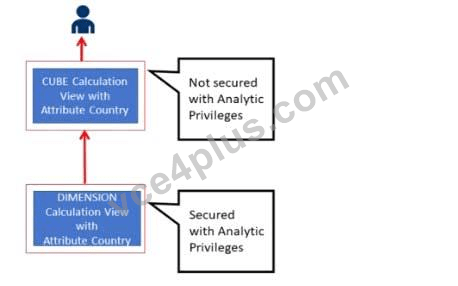
which privileges would a user require to view United States data when querying the CUBE calculation view?
A) A SELECT privilege and an Analytic Privilege (Country = United States) on the CUBE calculation view
B) SELECT privileges and Analytic Privileges (Country = United States) on both views
C) A SELECT privilege on the CUBE calculation view and an Analytic Privilege (Country = United States) on the DIMENSION calculation view
D) A SELECT privilege and an Analytic Privilege (Country = United States) on the DIMENSION calculation view
2. You want to create a star schema using a calculation view. The measures are based on columns from two transaction tables. DIMENSION calculation views provide the attributes.What is the correct approach?
A) Combine the transaction tables using a join node in a calculation view of type CUBE with star join.Use a star join node to join the DIMENSIONS to the fact table.
B) Combine the transaction tables using an aggregation node in a calculation view of type CUBE with star join./Use a star join node to join the DIMENSIONS to the fact table.
C) Combine the transaction tables using a star join node in a calculation view of type CUBE with star join./Use a join node to join the DIMENSIONS to the fact table.
D) Combine the transaction tables using a star join node in a calculation view of type CUBE with star join.Use the same star join node to connect the DIMENSIONS to the fact table.
3. Why might you use the Keep Flag property in an aggregation node?
A) To exclude columns that are NOT requested by a query to avoid incorrect results
B) To retain the correct aggregation behavior in stacked views
C) To include columns that are NOT requested by a query but are essential for the correct result
D) To ensure that the aggregation behavior defined in the aggregation node for a measure CANNOT be overridden by a query
4. Which solutions form the SAP Business Technology Platform? Note: There are 2 correct answers to this question.
A) Analytics
B) Intelligent Suite
C) Experience Management
D) Application Development & Integration
5. In a calculation view, why would you implement an SQL expression? Note: There are 3 correct answers to this question.
A) To generate a restricted column
B) To define a filter
C) To generate a calculated column
D) To convert currencies
E) To generate hierarchies
Solutions:
| Question # 1 Answer: C | Question # 2 Answer: A | Question # 3 Answer: C | Question # 4 Answer: A,D | Question # 5 Answer: A,B,C |
 587 Customer Reviews

