

Netskope NSK300 Dumps - 100% Cover Real Exam Questions (Updated 83 Questions)
Real NSK300 dumps - Real Netskope dumps PDF
Netskope NSK300 Exam Syllabus Topics:
| Topic | Details |
|---|---|
| Topic 1 |
|
| Topic 2 |
|
| Topic 3 |
|
| Topic 4 |
|
| Topic 5 |
|
NEW QUESTION # 12
You are configuring Administrator SSO using SAML 2.0 with roles based on group membership. In this scenario, how is the administrator group passed from the IdP within the SAML assertion to Netskope?
- A. using GROUP_NAME
- B. using ADMIN-GROUP
- C. using ADMIN-ROLE
- D. using OU-GROUP
Answer: A
Explanation:
When configuring SAML 2.0 SSO for Netskope administrator access with group-based role assignment, the administrator's group membership must be communicated from the Identity Provider to Netskope within the SAML assertion. Netskope expects the group attribute to be passed using the attribute name
"GROUP_NAME" in the SAML response. This attribute maps the IdP group membership to the corresponding admin role configured within the Netskope tenant. If the attribute name does not match exactly, for example if "ADMIN-GROUP" or "OU-GROUP" is used instead, Netskope will not be able to resolve the group assignment and the administrator will either receive no role or default-level permissions. This attribute name convention is explicitly documented in Netskope's SAML SSO configuration guide for administrator access management.
NEW QUESTION # 13
You are implementing a solution to deploy Netskope for machine traffic in an AWS account across multiple VPCs. You want to deploy the least amount of tunnels while providing connectivity for all VPCs.
How would you accomplish this task?
- A. Use IPsec tunnels from the AWS Transit Gateway.
- B. Use GRE tunnels from the AWS Virtual Private Gateway
- C. Use IPsec tunnels from the AWS Virtual Private Gateway.
- D. Use GRE tunnels from the AWS Transit Gateway.
Answer: A
Explanation:
The best approach to deploy Netskope for machine traffic across multiple VPCs in an AWS account with the least amount of tunnels while providing connectivity for all VPCs is to useIPsec tunnels from the AWS Transit Gateway.This method allows you to use the same Site-to-Site VPN connection to Netskope for multiple VPCs, thus minimizing the number of tunnels required12. The AWS Transit Gateway acts as a network transit hub, enabling you to connect your VPCs and on-premises networks through a central point of management and control.Using IPsec tunnels with the AWS Transit Gateway ensures that all VPCs connected to it utilize the same IPsec tunnel between the transit gateway and Netskope POP1.
Detailed guidance on configuring IPsec VPN tunnels between your AWS Transit Gateway and Netskope POPs can be found in the Netskope Knowledge Portal1.Additionally, the Netskope Community Forum provides insights on setting up IPsec Tunnels for AWS egress traffic, which includes information relevant to deploying Netskope across multiple VPCs2.
NEW QUESTION # 14
A company needs to block access to their instance of Microsoft 365 from unmanaged devices. They have configured Reverse Proxy and have also created a policy that blocks login activity for the AD group "marketing-users" for the Reverse Proxy access method. During UAT testing, they notice that access from unmanaged devices to Microsoft 365 is not blocked for marketing users.
What is causing this issue?
- A. There is a missing group name in the SAML response.
- B. The username in the name ID field is not in the format of the e-mail address.
- C. There is an invalid certificate in the SAML response.
- D. The username in the name ID field does not have the "marketing-users" group name.
Answer: A
Explanation:
The issue is likely caused by a missing group name in the SAML response (A). When access to Microsoft 365 from unmanaged devices is not blocked as expected, despite having a policy in place, it often indicates that the SAML assertion is not correctly identifying the user as a member of the restricted group. In this case, the "marketing-users" group name should be present in the SAML response to enforce the policy that blocks login activity for this group. If the group name is missing, the policy will not apply, and users will not be blocked as intended.
NEW QUESTION # 15
Given the following:
Which result does this Skope IT query provide?
- A. The query returns all events of an IP address downloading or uploading to or from Amazon S3 using the Netskope Client.
- B. The query returns all events of [email protected] downloading or uploading to or from the application "Amazon S3" using the Netskope Client.
- C. The query returns all events of [email protected] downloading or uploading to or from the site
'Amazon S3" using the Netskope Client. - D. The query returns all events of everyone except [email protected] downloading or uploading to or from the site "Amazon S3" using the Netskope Client.
Answer: C
Explanation:
* The given Skope IT query specifies the following conditions:
* User equals '[email protected]'
* Access method equals 'Client'
* Activity equals 'Download' or 'Upload'
* Site equals 'Amazon S3'
* The query combines these conditions using logical operators (AND and OR).
* The result of this query will include all events where the specified user ('[email protected]') is either downloading or uploading data to or from the site 'Amazon S3' using the Netskope Client.
* It does not include events related to other users or IP addresses. References:
* Netskope Security Cloud Introductory Online Technical Training
* Netskope Security Cloud Operation & Administration (NSCO&A) - Classroom Training
NEW QUESTION # 16
A company's architecture includes a server subnet that is logically isolated from the rest of the network with no Internet access, no default gateway, and no access to DNS. New resources can only be provisioned on virtual resources in that segment and there is a firewall that is tunnel-capable securing the perimeter of the segment. The only requirement is to have content filtering for any server that might access the Internet using a browser.
Which two Netskope deployment methods would achieve this requirement? (Choose two.)
- A. Deploy Data Plane on Premises (DPoP) with a proxy configuration on the servers.
- B. Deploy IPsec or GRE tunnels in the segment to steer traffic from the servers to Netskope.
- C. Deploy a mobile profile on the servers.
- D. Install the Netskope Client on the servers
Answer: A,B
Explanation:
For a server subnet that is isolated and requires content filtering for any server that might access the Internet using a browser, the two Netskope deployment methods that would meet this requirement are:
B . Deploy Data Plane on Premises (DPoP) with a proxy configuration on the servers: Deploying DPoP would allow the isolated servers to connect to the Netskope cloud for content filtering through a proxy configuration. This setup would enable the servers to have controlled access to the Internet for content filtering purposes without requiring direct Internet access1.
C . Deploy IPsec or GRE tunnels in the segment to steer traffic from the servers to Netskope: By deploying IPsec or GRE tunnels, the traffic from the servers can be securely directed to Netskope for content filtering. This method is suitable for environments where servers do not have direct Internet access, as the tunnel provides a secure path for traffic to reach Netskope's cloud services1.
These deployment methods are designed to work in environments with strict network isolation and provide the necessary content filtering capabilities for servers accessing the Internet.
NEW QUESTION # 17
You are already using Netskope CSPM to monitor your AWS accounts for compliance. Now you need to allow access from your company-managed devices running the Netskope Client to only Amazon S3 buckets owned by your organization. You must ensure that any current buckets and those created in the future will be allowed Which configuration satisfies these requirements?
- A. Steering: Cloud Apps Only, All Traffic Policy type: Real-time ProtectionConstraint: Storage. Bucket Does Not Match -ALLAccounts Action: Block
- B. Steering: Cloud Apps Only. All Traffic Policy type: Real-time Protection Constraint: Storage. Bucket Does Match -ALLAccounts Action: Allow
- C. Steering: All Web Traffic Policy type: API Data ProtectionConstraint: Storage, Bucket Does Match
*@myorganization.com Action: Allow - D. Steering: Cloud Apps Only Policy type: Real-time ProtectionConstraint: Storage. Bucket Does Not Match *@myorganization.com Action: Block
Answer: A
Explanation:
To restrict access to only organizationally owned Amazon S3 buckets, the correct approach involves configuring a Real-time Protection policy that leverages Netskope's instance-awareness capabilities. The "- ALLAccounts" constraint identifier is a Netskope feature that dynamically references all cloud accounts discovered and managed under the organization's CSPM configuration. By creating a policy with the constraint "Storage Bucket Does Not Match -ALLAccounts" and setting the action to Block, any traffic destined for non-organizational S3 buckets is blocked automatically. This approach is dynamic, meaning newly created organizational accounts are automatically included as CSPM discovers them. Steering must be set to All Traffic to ensure this policy applies comprehensively, not just to recognized cloud app categories.
NEW QUESTION # 18
You receive a report from your endpoint team that a device may no longer be running the Netskope Client.
You only know the hostname of the machine in question. You want to remotely verify whether the client is still installed and steering traffic and which user is assigned to the device. In this scenario, how would you accomplish this task?
- A. Under Skope IT Users, look at the Users Over Time graph for any anomalies.
- B. Under Skope IT Applications Events, query by hostname and determine the last event date and time.
- C. Under the Netskope Client Devices page, search for the hostname in question and identify the current Client Status and User information.
- D. Enable IP restrictions for a sanctioned application and see if any users report an access problem.
Answer: C
Explanation:
The Netskope Client Devices page within the Netskope tenant provides a centralized inventory of all devices on which the Netskope Client has been installed and registered. By searching for a specific hostname in this interface, administrators can immediately verify whether the client is currently installed and reporting on that device, view the current client status such as active, inactive, or tunnel connected, and identify which user is currently or was last assigned to the device. This is the most direct and efficient method for remotely verifying client installation and steering status without requiring direct access to the endpoint itself. Skope IT Application Events could show historical activity but would not confirm the current client installation state or user assignment as reliably as the dedicated Client Devices page.
NEW QUESTION # 19
Review the exhibit.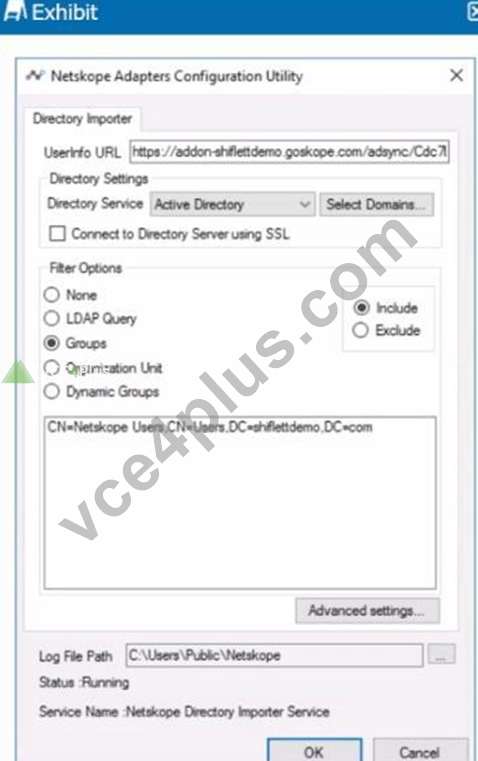
You installed Directory Importer and configured it to import specific groups ot users into your Netskope tenant as shown in the exhibit. One hour after a new user has been added to the domain, the user still has not been provisioned to Netskope.
What are three potential reasons for this failure? (Choose three.)
- A. Active Directory integration is not enabled on your tenant.
- B. The server that the Directory Importer is installed on is unable to reach Netskope ' s add-on endpoint.
- C. The default collection interval is 180 minutes, therefore a sync may not have run yet.
- D. Directory Importer does not support ongoing user syncs; you must manually provision the user.
- E. The user is not a member of the group specified as a filter
Answer: B,C,E
Explanation:
When Directory Importer is configured to sync users from Active Directory to Netskope, several conditions must be met for successful provisioning. Three potential reasons a newly added user may not appear in Netskope after one hour include: first, the Directory Importer server may be unable to reach Netskope's add- on endpoint, preventing the sync data from being uploaded; second, the new user may not be a member of the AD group specified as the filter in the Directory Importer configuration, meaning they would be excluded from the sync scope; and third, the default collection interval for Directory Importer is 180 minutes, so if a sync cycle has not yet run since the user was added, the provisioning delay is expected behavior. Active Directory integration being globally disabled would affect all users, not just newly added ones.
NEW QUESTION # 20
You want to verify that Google Drive is being tunneled to Netskope by looking in the nsdebuglog file. You are using Chrome and the Netskope Client to steer traffic. In this scenario, what would you expect to see in the log file?
- A.

- B.

- C.

- D.

Answer: A
Explanation:
When verifying that Google Drive traffic is being tunneled to Netskope using Chrome and the Netskope Client, you would expect to see log entries indicating that the traffic is being directed through Netskope's proxy. Specifically, Option A is correct as it shows the process "google drive" being tunneled to nsProxy. The log entry for Option A indicates that a TLS tunneling flow from a local address and process (Google Drive) is being directed to a host (play.googleapis.com) and then to Netskope's proxy (nsProxy). This is consistent with how Netskope tunnels specified traffic for security and policy enforcement1.
NEW QUESTION # 21
You want to enable the Netskope Client to automatically determine whether it is on-premises or off-premises.
Which two options in the Netskope Ul would you use to accomplish this task? (Choose two.)
- A. the New Exception option in the Traffic Steering options of the Ul
- B. the All Traffic option in the Steering Configuration section of the Ul
- C. the Enable Dynamic Steering option in the Steering Configuration section of the Ul
- D. the On Premises Detection option under the Client Configuration section of the Ul
Answer: C,D
Explanation:
To enable the Netskope Client to automatically determine whether it is on-premises or off-premises, you can use the following options in the Netskope UI:
* Enable Dynamic Steering:
* This option is available in the Steering Configuration section of the UI.
* By enabling dynamic steering, the Netskope Client can intelligently determine the appropriate data plane (on-premises or cloud) based on the user's location and network conditions.
* It ensures that traffic is directed to the optimal data plane for improved performance and security.
Reference: Netskope Documentation on Dynamic Steering
On Premises Detection:
This option is available under the Client Configuration section of the UI.
By configuring on-premises detection, the Netskope Client can identify whether it is connected to the local network (on-premises) or accessing resources from outside (off-premises).
It helps in applying relevant policies and steering traffic accordingly.
Reference: Netskope Documentation on Client Configuration
NEW QUESTION # 22
You are already using Netskope CSPM to monitor your AWS accounts for compliance. Now you need to allow access from your company-managed devices running the Netskope Client to only Amazon S3 buckets owned by your organization. You must ensure that any current buckets and those created in the future will be allowed Which configuration satisfies these requirements?
- A. Steering: Cloud Apps Only. All Traffic Policy type: Real-time Protection Constraint: Storage. Bucket Does Match -ALLAccounts Action: Allow
- B. Steering: Cloud Apps Only Policy type: Real-time Protection
Constraint: Storage. Bucket Does Not Match *@myorganization.com Action: Block - C. Steering: Cloud Apps Only, All Traffic Policy type: Real-time Protection Constraint: Storage. Bucket Does Not Match -ALLAccounts Action: Block
- D. Steering: All Web Traffic Policy type: API Data Protection
Constraint: Storage, Bucket Does Match *@myorganization.com Action: Allow
Answer: C
NEW QUESTION # 23
You are asked to create a Real-time Protection policy to inspect outbound e-mail for DLP violations. You must prevent sensitive e-mail from leaving the corporate mail relay.
In this scenario, which Real-time Protection policy action must be specified?
- A. Add SMTP Header
- B. Forward to Proxy
- C. Block
- D. Alert
Answer: A
NEW QUESTION # 24
You deployed Netskope Cloud Security Posture Management (CSPM) using pre-defined benchmark rules to monitor your cloud posture in AWS, Azure, and GCP. You are asked to assess if you can extend the Netskope CSPM solution by creating custom rules for each environment.
Which statement is correct?
- A. Custom rules using Domain Specific Language are only available when using SSPM.
- B. With Netskope CSPM, you can create custom rules using Domain Specific Language for AWS. Azure, and GCP
- C. With Netskope CSPM, you can create custom rules using Domain Specific Language for AWS. Azure, but not for GCP.
- D. You will need to evaluate SaaS Security Posture Management (SSPM) in addition to CSPM so that rules applied to GCP will align with Google Workspace
Answer: B
Explanation:
Netskope Cloud Security Posture Management (CSPM) allows for the creation of custom rules using Domain Specific Language (DSL) for all three major cloud platforms: AWS, Azure, and GCP. This capability is integral to CSPM and enables organizations to tailor their security posture assessments to their specific needs across different cloud environments.
The ability to create custom rules using DSL within Netskope CSPM for AWS, Azure, and GCP is documented in the Netskope Knowledge Portal. It provides detailed instructions on how to build custom rules under Policies > Security Posture > Profiles & Rules for security assessment of resources across these cloud platforms
NEW QUESTION # 25
Your Netskope Client tunnel has connected to Netskope; however, the user is not receiving any steering or client configuration updates What would cause this issue?
- A. The client is unable to establish communication to add-on-[tenant].goskope.com.
- B. The Netskope Client service is not running.
- C. The client is unable to establish communication to gateway-[tenant].goskope.com.
- D. An invalid steering exception was created in the tenant
Answer: A
Explanation:
The Netskope Client establishes a data tunnel for traffic steering, but it also requires a separate communication channel to the Netskope add-on endpoint (add-on-[tenant].goskope.com) to receive configuration updates, steering policies, and client profile changes. If this endpoint is unreachable due to a firewall rule or network policy blocking the connection, the client will continue to pass traffic through its established tunnel but will not receive any new steering or client configuration updates from the tenant. This means policy changes, steering exceptions, or client configuration modifications made in the Netskope UI will not be pushed to the affected client. This is a common troubleshooting finding in environments with strict egress filtering, and the resolution involves ensuring that the add-on endpoint is reachable from all client devices.
NEW QUESTION # 26
You are asked to create a customized restricted administrator role in your Netskope tenant for a newly hired employee. Which two statements are correct in this scenario? (Choose two.)
- A. The scope of the data shown in the Ul can be restricted to specific events.
- B. An admin role prevents admins from downloading and viewing file content by default.
- C. Obfuscation can be applied to all functional areas.
- D. All role privileges default to Read Only for all functional areas.
Answer: A,C
NEW QUESTION # 27
You do not want a scheduled Advanced Analytics dashboard to be automatically updated when Netskope makes improvements to that dashboard. In this scenario, what would you do to retain the original dashboard?
- A. Download the dashboard you want and Import from File into your Group or Personal folder.
- B. Create a new dashboard from scratch that mimics the Netskope dashboard you want to use.
- C. Ask Netskope Support to provide the dashboard and import into your Personal folder.
- D. Copy the dashboard into your Group or Personal folders and schedule from these folders.
Answer: A
Explanation:
* To retain the original dashboard without automatic updates due to improvements made by Netskope, you can download the desired dashboard and then import it from a file into your Group or Personal folder.
* This approach ensures that you have a static version of the dashboard that won't be affected by future changes or enhancements. References:
* The answer is based on general knowledge of dashboard management and customization within Netskope.
NEW QUESTION # 28
You are troubleshooting an issue with users who are unable to reach a financial SaaS application when their traffic passes through Netskope. You determine that this is because of IP restrictions in place with the SaaS vendor. You are unable to add Netskope's IP ranges at this time, but need to allow the traffic.
How would you allow this traffic?
- A. Use Explicit Proxy Over Tunnel (EPoT) so the traffic will egress from the corporate data center.
- B. Use an IPsec tunnel to forward traffic so it will egress from the corporate data center
- C. Use NPAto implement Source IP anchonng so the traffic will egress from the corporate data center.
- D. Use Cloud Explicit Proxy so the traffic will egress from the corporate data center
Answer: A
NEW QUESTION # 29
You created a Real-time Protection policy that blocks all activities to non-corporate S3 buckets, but determine that the policy is too restrictive. Specifically, users are complaining that normal websites have stopped rendering properly.
How would you solve this problem?
- A. Create a Real-time Protection policy to allow the Download activity to the Cloud Storage category
- B. Create a Real-time Protection policy to allow the Download activity to the Amazon S3 application
- C. Create a Real-time Protection policy to allow the Browse activity to the Amazon S3 application.
- D. Create a Real-time Protection policy to allow the Browse activity to the Cloud Storage category
Answer: D
Explanation:
To solve the problem of normal websites not rendering properly due to a Real-time Protection policy that blocks all activities to non-corporate S3 buckets, the best solution is to create a Real-time Protection policy to allow the Browse activity to the Cloud Storage category. This approach will enable users to view content from various cloud storage services, including Amazon S3, without allowing full access to non-corporate S3 buckets. It's a more granular and less restrictive policy that allows necessary browsing activities while still maintaining control over the upload and download activities to non-corporate buckets1.
NEW QUESTION # 30
You are currently designing a policy for AWS S3 bucket scans with a custom DLP profile Which policy action (s) are available for this policy?
- A. Alert, Quarantine
- B. Alert, Quarantine. Block, User Notification
- C. Alert only
- D. Alert, User Notification
Answer: A
Explanation:
When designing a policy for AWS S3 bucket scans with a custom DLP profile in Netskope, the available policy actions are Alert and Quarantine. These actions allow you to be notified when a policy violation occurs and to quarantine sensitive data to prevent potential data loss or exposure. The Alert action will notify the designated personnel or system when a match to the DLP profile is found during the scan. The Quarantine action will move the offending file to a secure location where it can be reviewed and dealt with appropriately1.
The information about policy actions for AWS S3 bucket scans is available in the Netskope documentation, which provides guidance on creating API Data Protection policies for scanning S3 buckets and the actions that can be taken when a policy is triggered1.
NEW QUESTION # 31
Your client is an NG-SWG customer. They are going to use the Explicit Proxy over Tunnel (EPoT) steering method. They have a specific list of domains that they do not want to steer to the Netskope Cloud.
What would accomplish this task?
- A. Use an SSL decryption policy.
- B. Create a real-time policy with a bypass action.
- C. Define exceptions in the Netskope steering configuration
- D. Define exception domains in the PAC file.
Answer: D
Explanation:
When using Explicit Proxy over Tunnel (EPoT) as the Netskope steering method, the Netskope Client establishes a tunnel to the Netskope cloud and forwards proxy traffic through it. If specific domains need to be excluded from this steering such as internal applications or trusted third-party services, the correct approach is to define exception domains directly in the PAC (Proxy Auto-Configuration) file. The PAC file logic can route traffic for excluded domains to DIRECT, bypassing the Netskope proxy, while all other traffic is directed through the EPoT tunnel. Steering exceptions in the Netskope tenant UI apply to client-based steering but do not control PAC file behavior. Real-time Protection bypass actions and SSL decryption policies operate after traffic has already been steered to Netskope and cannot intercept traffic before it enters the tunnel.
NEW QUESTION # 32
You are the network architect for a company using Netskope Private Access. Multiple users are reporting that they are unable to access an application using Netskope Private Access that was working previously. You have verified that the Real-time Protection policy allows access to the application, private applications are steered for the users, and the application is reachable from internal machines. You must verify that the application is reachable through Netskope Publisher In this scenario, which two tools in the Netskope Ul would you use to accomplish this task? (Choose two.)
- A. Clear Private App Auth under Users in Skope IT
- B. Troubleshooter tool in the App Definitions page
- C. Reachability Via Publisher in the App Definitions page
- D. Applications in Skope IT
Answer: B,C
Explanation:
In the scenario where users are unable to access an application through Netskope Private Access, and after verifying that the Real-time Protection policy allows access, the application is steered for the users, and it is reachable from internal machines, the next step is to verify the application's reachability through the Netskope Publisher. The two tools in the Netskope UI that would be used to accomplish this task are:
A). Reachability Via Publisher in the App Definitions page - This tool allows you to check if the application is reachable through the configured Publishers. It is essential to ensure that the application's connectivity is intact and that there are no issues with the Publishers themselves.
B). Troubleshooter tool in the App Definitions page - The Troubleshooter tool can help diagnose and resolve issues related to application reachability. It provides insights into potential problems and offers guidance on how to fix them.
These tools are designed to assist in troubleshooting and ensuring that applications are accessible through Netskope Private Access.
The explanation is based on the standard procedures for managing private applications and troubleshooting within the Netskope Private Access environment as outlined in the Netskope Knowledge Portal
NEW QUESTION # 33
You need to monitor the health of configured IPsec or GRE tunnels.
In this scenario, which two methods are supported by Netskope to accomplish this task? (Choose two.)
- A. Use Netskope Trust Portal.
- B. Use Layer 4 health checks.
- C. Use ICMP keepalive probing.
- D. Use Dead Peer Detection.
Answer: B,D
Explanation:
Netskope provides two built-in mechanisms to monitor the health of IPsec and GRE tunnels configured in the platform. Layer 4 health checks use TCP or UDP probes to verify end-to-end connectivity and reachability through the tunnel, providing active validation that the data path is functional. Dead Peer Detection (DPD) is an IKEv2 protocol mechanism that periodically confirms that the remote peer is still reachable and responsive; if the peer fails to respond, the tunnel is considered down and a re-establishment attempt is initiated automatically. ICMP keepalive probing is not a Netskope-native tunnel health monitoring feature, and the Netskope Trust Portal provides platform-wide service availability status rather than individual tenant- specific tunnel health monitoring.
NEW QUESTION # 34
You created a Real-time Protection policy that blocks all activities to non-corporate S3 buckets, but determine that the policy is too restrictive. Specifically, users are complaining that normal websites have stopped rendering properly.
How would you solve this problem?
- A. Create a Real-time Protection policy to allow the Download activity to the Cloud Storage category
- B. Create a Real-time Protection policy to allow the Download activity to the Amazon S3 application
- C. Create a Real-time Protection policy to allow the Browse activity to the Amazon S3 application.
- D. Create a Real-time Protection policy to allow the Browse activity to the Cloud Storage category
Answer: D
Explanation:
When a Real-time Protection policy blocks all activities to non-corporate S3 buckets, it can inadvertently affect websites that use Amazon S3 as a content delivery or asset hosting platform. These websites load images, JavaScript files, and other static assets from S3 URLs, which are classified under the Cloud Storage category rather than as direct S3 application traffic. To resolve this without weakening the S3 tenant restriction policy, a new Real-time Protection policy should be created to allow the Browse activity specifically for the Cloud Storage category. This allows pass-through access to web content hosted on cloud storage platforms while still blocking direct upload or download activities to unauthorized S3 buckets.
Allowing Browse on the Amazon S3 application only would be too narrow and may not cover all affected CDN and asset-hosting behaviors.
NEW QUESTION # 35
You have an NG-SWG customer that currently steers all Web traffic to Netskope using the Netskope Client.
They have identified one new native application on Windows devices that is a certificate-pinned application.
Users are not able to access the application due to certificate pinning. The customer wants to configure the Netskope Client so that the traffic from the application is steered to Netskope and the application works as expected.
Which two methods would satisfy the requirements? (Choose two.)
- A. Tunnel traffic to Netskope and bypass traffic inspection at the Netskope proxy.
- B. Configure the SSL Do Not Decrypt policy to not decrypt traffic for domains used by the native application.
- C. Configure domain exceptions in the steering configuration for the domains used by the native application.
- D. Bypass traffic using the bypass action in the Real-time Protection policy.
Answer: A,B
NEW QUESTION # 36
You are implementing Netskope Cloud Exchange in your company lo include functionality provided by third- party partners. What would be a reason for using Netskope Cloud Risk Exchange in this scenario?
- A. to feed SOC with detection and response services
- B. to automate service tickets from alerts of interest
- C. to ingest events and alerts from a Netskope tenant
- D. to map multiple scores to a normalized range
Answer: B
Explanation:
Netskope Cloud Exchange is a modular platform that facilitates integration between Netskope and third-party security tools through a set of exchange modules. The Cloud Ticket Orchestrator (CTO) module is specifically designed to automate the creation of ITSM service tickets based on Netskope alerts and events of interest. This allows security operations teams to automatically generate incidents or trouble tickets in platforms such as ServiceNow or Jira when predefined security conditions are met, reducing manual SOC workload and ensuring timely escalation of critical events. The Cloud Risk Exchange (CRE) module handles risk score normalization, while the Cloud Log Shipper handles event forwarding, and Cloud Threat Exchange manages IOC sharing between security tools.
NEW QUESTION # 37
......
Realistic VCE4Plus NSK300 Dumps PDF - 100% Passing Guarantee: https://braindumpsschool.vce4plus.com/Netskope/NSK300-valid-vce-dumps.html