

Sep-2026 FREE Juniper JN0-351 PRACTICE QUESTIONS AND ANSWERS UPDATES
DEMO FREE BEFORE YOU BUY JN0-351 DUMPS
Juniper JN0-351 Exam Syllabus Topics:
| Topic | Details |
|---|---|
| Topic 1 |
|
| Topic 2 |
|
| Topic 3 |
|
| Topic 4 |
|
| Topic 5 |
|
| Topic 6 |
|
NEW QUESTION # 104
Exhibit.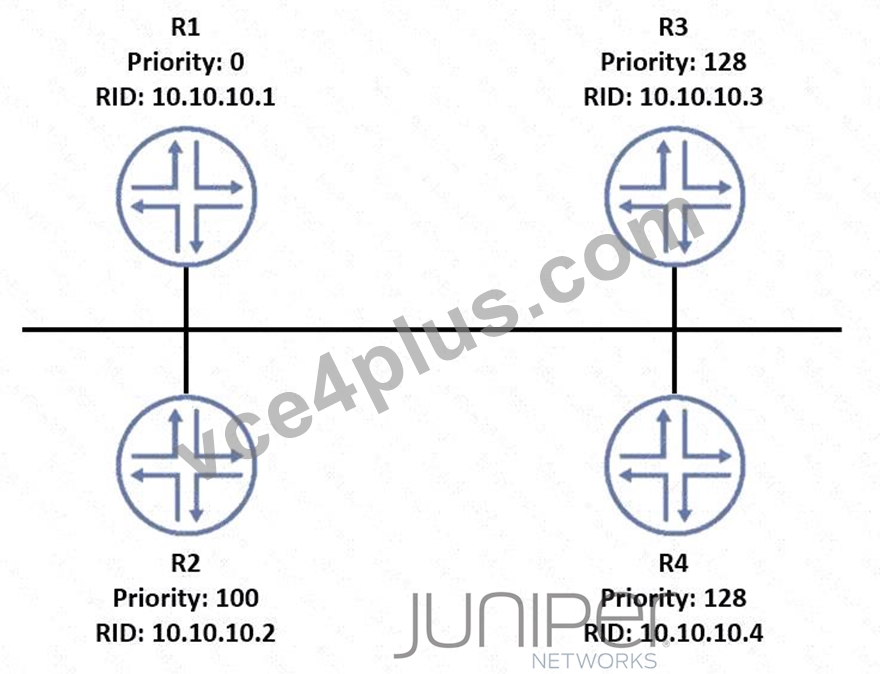
Which router will become the OSPF BDR if all routers are powered on at the same time?
- A. R1
- B. R3
- C. R2
- D. R4
Answer: D
Explanation:
OSPF DR/BDR election is a process that occurs on multi-access data links. It is intended to select two OSPF nodes: one to be acting as the Designated Router (DR), and another to be acting as the Backup Designated Router (BDR). The DR and BDR are responsible for generating network LSAs for the multi-access network and synchronizing the LSDB with other routers on the same network 1 .
The DR/BDR election is based on two criteria: the OSPF priority and the router ID. The OSPF priority is a value between 0 and 255 that can be configured on each interface participating in OSPF. The default priority is 1. A priority of 0 means that the router will not participate in the election and will never become a DR or BDR. The router with the highest priority will become the DR, and the router with the second highest priority will become the BDR. If there is a tie in priority, then the router ID is used as a tie-breaker. The router ID is a
32-bit number that uniquely identifies each router in an OSPF domain. It can be manually configured or automatically derived from the highest IP address on a loopback interface or any active interface 2 .
In this scenario, all routers have the same priority of 1, so the router ID will determine the outcome of the election. The router IDs are shown in the exhibit as RID values. The highest RID belongs to R4 (10.10.10.4), so R4 will become the DR. The second highest RID belongs to R3 (10.10.10.3), so R3 will become the BDR.
References:
1 : OSPF DR/BDR Election: Process, Configuration, and Tuning 2 : OSPF Designated Router (DR) and Backup Designated Router (BDR)
NEW QUESTION # 105
You are receiving multiple BGP routes from an upstream neighbor and only want to advertise a single summarized prefix to your internal OSPF neighbors. This route should only be advertised when you are receiving these BGP routes from this neighbor.
In this scenario, which type of route should you create?
- A. aggregate route
- B. static route using the resolve feature
- C. generate route
- D. static route using qualified next hops
Answer: A
Explanation:
Explanation
In this scenario, you should create an 1. Aggregate routes are used for advertising summarized network prefixes1. They help minimize the number of routing tables in an IP network by consolidating selected multiple routes into a single route advertisement1. This approach is in contrast to non-aggregation routing, in which every routing table contains a unique entry for each route1.
Therefore, option A is correct. Options B, C, and D are not correct because:
Static route using the resolve feature: This type of route uses the resolve feature to install a static route in the routing table only if a specific condition is met1. However, it does not provide the capability to summarize multiple routes into a single prefix.
Generate route: This type of route generates a route that is always present in the routing table and can be used to summarize routes. However, it does not have the capability to only advertise the route when specific BGP routes are being received from a neighbor1.
Static route using qualified next hops: This type of route allows for the specification of multiple next-hop addresses for a static route1. However, it does not provide the capability to summarize multiple routes into a single prefix.
NEW QUESTION # 106
You are asked to create a new firewall filter to evaluate Layer 3 traffic that is being sent between VLANs. In this scenario, which two statements are correct? (Choose two.)
- A. You should create a family inet firewall filter with the appropriate match criteria and actions.
- B. You should create a family Ethernet-switching firewall filter with the appropriate match criteria and actions.
- C. You should apply the firewall filter to the appropriate IRB interface.
- D. You should apply the firewall filter to the appropriate VLAN.
Answer: A,C
Explanation:
A firewall filter is a configuration that defines the rules that determine whether to forward or discard packets at specific processing points in the packet flow. A firewall filter can also modify the attributes of the packets, such as priority, marking, or logging. A firewall filter can be applied to various interfaces, protocols, or routing instances on a Juniper device 1 .
A firewall filter has a family attribute, which specifies the type of traffic that the filter can evaluate. The family attribute can be one of the following: inet, inet6, mpls, vpls, iso, or ethernet-switching 2 . The family inet firewall filter is used to evaluate IPv4 traffic, which is the most common type of Layer 3 traffic on a network.
To create a family inet firewall filter, you need to specify the appropriate match criteria and actions for each term in the filter. The match criteria can include various fields in the IPv4 header, such as source address, destination address, protocol, port number, or DSCP value. The actions can include accept, discard, reject, count, log, policer, or next term 3 .
To apply a firewall filter to Layer 3 traffic that is being sent between VLANs, you need to apply the filter to the appropriate IRB interface. An IRB interface is an integrated routing and bridging interface that provides Layer 3 functionality for a VLAN on a Juniper device. An IRB interface has an IP address that acts as the default gateway for the hosts in the VLAN. An IRB interface can also participate in routing protocols and forward packets to other VLANs or networks 4 .
Therefore, option C is correct, because you should create a family inet firewall filter with the appropriate match criteria and actions. Option D is correct, because you should apply the firewall filter to the appropriate IRB interface.
Option A is incorrect, because you should not create a family ethernet-switching firewall filter with the appropriate match criteria and actions. A family ethernet-switching firewall filter is used to evaluate Layer 2 traffic on a Juniper device. A family ethernet-switching firewall filter can only match on MAC addresses or VLAN IDs, not on IP addresses or protocols 5 .
Option B is incorrect, because you should not apply the firewall filter to the appropriate VLAN. A VLAN is a logical grouping of hosts that share the same broadcast domain on a Layer 2 network. A VLAN does not have an IP address or routing capability. A firewall filter cannot be applied directly to a VLAN; it must be applied to an interface that belongs to or connects to the VLAN 6 .
References:
1 : Firewall Filters Overview 2 : Configuring Firewall Filters 3 : Configuring Firewall Filter Match Conditions and Actions 4 : Understanding Integrated Routing and Bridging Interfaces 5 : Configuring Ethernet-Switching Firewall Filters 6 : Understanding VLANs
https://www.juniper.net/documentation/us/en/software/junos/routing-policy/topics/task/firewall-filter-qfx- series-cli.html
NEW QUESTION # 107
Which two statements are correct about tunnels? (Choose two.)
- A. IP-IP tunnels are stateful.
- B. BFD cannot be used to monitor tunnels.
- C. Tunnels add additional overhead to packet size.
- D. Tunnel endpoints must have a valid route to the remote tunnel endpoint.
Answer: C,D
Explanation:
For a tunnel to be established, the endpoints must have a route to each other. This is essential for the encapsulated packets to reach their destination.
Tunnels encapsulate packets, adding extra headers for the encapsulation protocol, which increases the overall packet size.
NEW QUESTION # 108
R1 has a BGP session with a router that has a peer autonomous system number of 64501. It is exchanging routes, and is advertising those routes to IBGP peers. The downstream IBGP peers, however, cannot pass traffic to the advertised networks.
Referring to the exhibit, which configuration change must occur to solve this problem?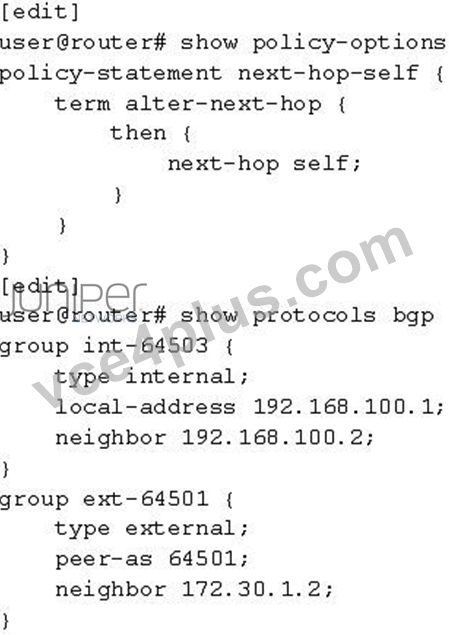
- A. The BGP group ext-64501 must include the import next-hop-selfpolicy.
- B. The BGP group ext-64501 must include the export next-hop-selfpolicy.
- C. The BGP group int-64503 must include the import next-hop-selfpolicy.
- D. The BGP group int-64503 must include the export next-hop-selfpolicy.
Answer: D
NEW QUESTION # 109
Which three protocols support BFD? (Choose three.)
- A. OSPF
- B. FTP
- C. LACP
- D. RSTP
- E. BGP
Answer: A,C,E
Explanation:
https://www.juniper.net/documentation/us/en/software/junos/high-availability/topics/topic-map/bfd- configuring.html
NEW QUESTION # 110
You want to verify prefix information being sent from 10.36.1.4.
Which two statements are correct about the output shown in the exhibit? (Choose two.)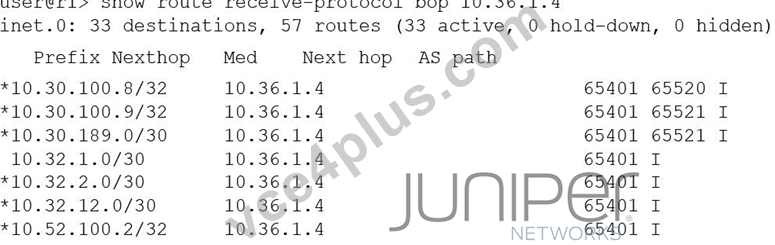
- A. The output shows routes that were received prior to the application of any BGP import policies.
- B. The routes displayed are being learned from an I BGP peer.
- C. The routes displayed have traversed one or more autonomous systems.
- D. The output shows routes that are active and rejected by an import policy.
Answer: A,C
Explanation:
The AS path attribute shows AS numbers (e.g., 65401 65520.), indicating the route's traversal through one or various autonomous systems.
The output displays the selected routes and the attributes with which they were received, but does not show the effects of import policy on the routing attributes.
Nothing indicates that the routes have been received from an IBGP peer. The asterisks only indicates whether the routes have been imported into the routing table (RIB) after the application of the import policies.
https://www.juniper.net/documentation/us/en/software/junos/cli-
reference/topics/ref/command/show-route-receive-protocol.html
NEW QUESTION # 111
Which command displays the output shown in the exhibit?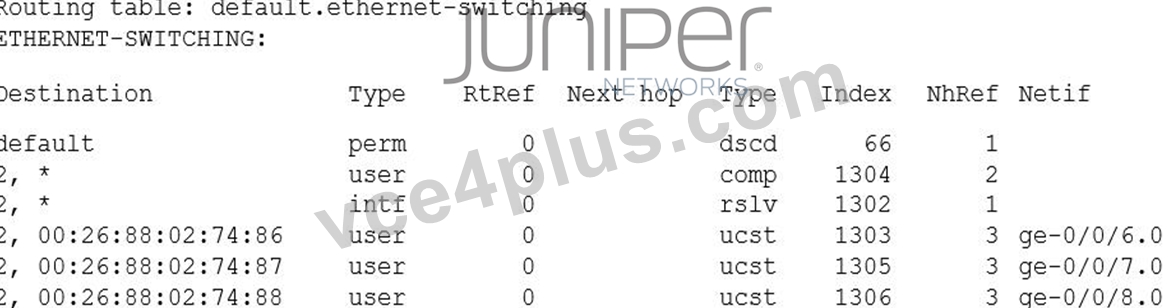
- A. show ethernet-switching table extensive
- B. show route forwarding-table
- C. show ethernet-switching table
- D. show route forwarding-table family ethernet-switching
Answer: C
Explanation:
This command shows the Ethernet switching table, which includes information about MAC addresses, their associated VLANs, and the interfaces they are learned on, similar to the output shown in your exhibit.
NEW QUESTION # 112
You enable persistent MAC learning on your Juniper switch. In this scenario, which statement is correct?
- A. You can enable persistent MAC learning on an interface where MAC learning is disabled.
- B. You can only enable persistent MAC learning on an interface on which 802.1x authentication is configured.
- C. You can enable persistent MAC learning on an interface that is part of a redundant trunk group.
- D. You can only enable persistent MAC learning on an interface in access mode.
Answer: D
NEW QUESTION # 113
Referring to the exhibit, what will be the IS-IS adjacency result of the configurations?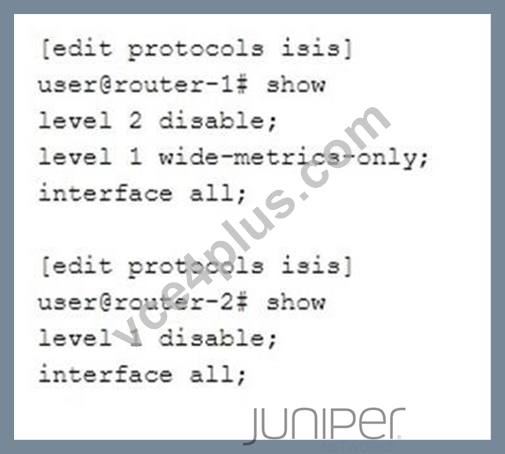
- A. A level 1 IS-IS adjacency will form.
- B. A level 2 IS-IS adjacency will form.
- C. No IS-IS adjacencies will form.
- D. A level 1 and level 2 IS-IS adjacency will form.
Answer: C
NEW QUESTION # 114
You are configuring an IS-IS IGP network and do not see the IS-IS adjacencies established. In this scenario, what are two reasons for this problem? (Choose two.)
- A. The lo0 interface is not included as an IS-IS interface.
- B. IP subnets are not a /30 address.
- C. The Level 2 routers have mismatched areas.
- D. MTU is not at least 1492 bytes.
Answer: A,D
Explanation:
Option A suggests that the MTU is not at least 1492 bytes. This is correct because IS-IS requires a minimum MTU of 1492 bytes to establish adjacencies. If the MTU is less than this, IS-IS adjacencies will not be established.
Option D suggests that the lo0 interface is not included as an IS-IS interface. This is also correct because the loopback interface (lo0) is typically used as the router ID in IS-IS. If the loopback interface is not included in IS-IS, it could prevent IS-IS adjacencies from being established.
NEW QUESTION # 115
Which statement is correct regarding Junos OS unicast reverse path forwarding (RPF) checks?
- A. RPF checks are used to prevent IP address spoofing by verifying that a packet arrives on the interface that would be used to route back to the source.
- B. RPF checks require BGP to function.
- C. RPF checks are only used for multicast traffic.
- D. RPF checks are applied only to outbound traffic.
Answer: A
Explanation:
Unicast Reverse Path Forwarding (RPF) is a security mechanism that verifies whether a received packet's source address is reachable through the interface on which it arrived, based on the routing table. If the check fails, indicating a potentially spoofed source address, the packet can be discarded, helping to prevent IP spoofing-based attacks.
NEW QUESTION # 116
Click the Exhibit button.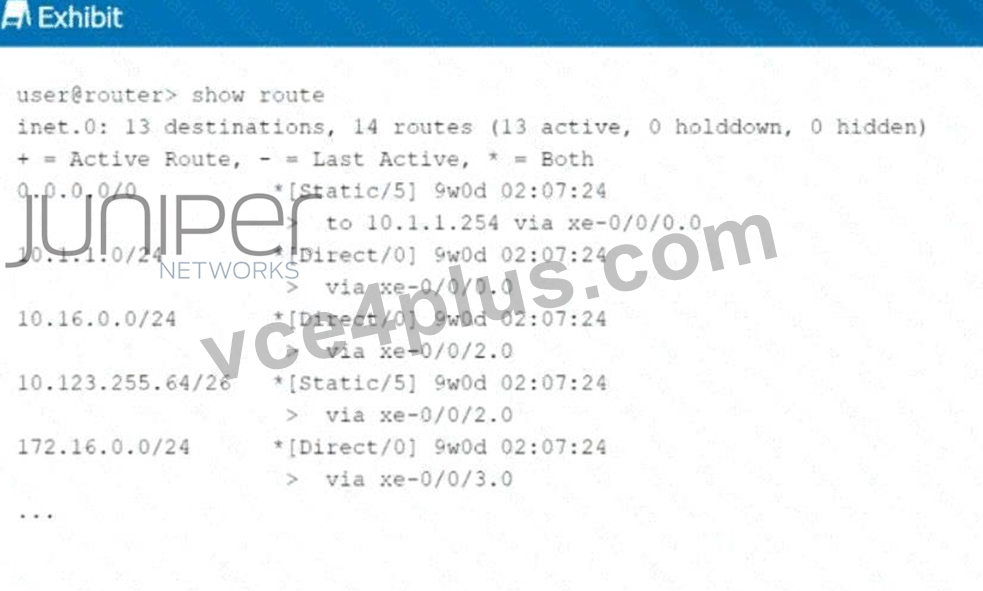
You want to redistribute the static routes into BGP, but they do not show as BGP routes.
What causes this result to occur?
- A. A community string must be configured.
- B. The static routes do not have a valid next hop.
- C. The no-readvertise feature is specified.
- D. The as-path parameter must be specified.
Answer: B
Explanation:
The static route to the 0.0.0.0/0 network has a next hop of xe-0/0/0.0, which is a local interface. BGP does not accept static routes with a local interface as the next hop, because it cannot advertise them to other BGP peers.
BGP requires a valid IP address as the next hop for static routes that are redistributed into BGP. To fix this issue, the static route should have a next hop of an IP address that is reachable via the xe-0/0/0.0 interface, such as the IP address of the eBGP neighbor. Alternatively, the next hop can be modified by using a route map when redistributing the static route into BGP12.
The other options are not correct because:
The as-path parameter is not required for redistributing static routes into BGP. The as-path attribute is automatically set by BGP when advertising routes to other BGP peers3.
A community string is not required for redistributing static routes into BGP. A community is an optional attribute that can be used to group routes and apply policies to them4.
The no-readvertise feature is not specified in the configuration. The no-readvertise feature is used to prevent routes learned from one iBGP peer from being advertised to another iBGP peer5.
References:
How to configure BGP to send the default route to a neighbor
Redistributing Static Route in to BGP - Cisco Community
BGP Fundamentals
BGP Communities Attribute
BGP No-Readvertise Feature
NEW QUESTION # 117
Which three statements are correct about OSPF packet types? (Choose three.)
- A. Link-state update packets contain one or more LSAs.
- B. Link-state request packets are sent after receiving an LSA header not in the OSPF database.
- C. Database description packets are used during the adjacency formation process.
- D. Link-state acknowledgment packets are sent every 30 seconds.
- E. Hello packets are sent every 30 seconds by default.
Answer: A,B,C
NEW QUESTION # 118
You are asked to change the setting for the LSAs age out back to the default value.
In this scenario, which time interval will accomplish this task?
- A. 3600 seconds
- B. 600 seconds
- C. 300 seconds
- D. 1800 seconds
Answer: A
Explanation:
https://www.juniper.net/documentation/us/en/software/junos/cli-reference/topics/ref/statement/lsa-refresh- interval-edit-protocols-ospf.html
NEW QUESTION # 119
Exhibit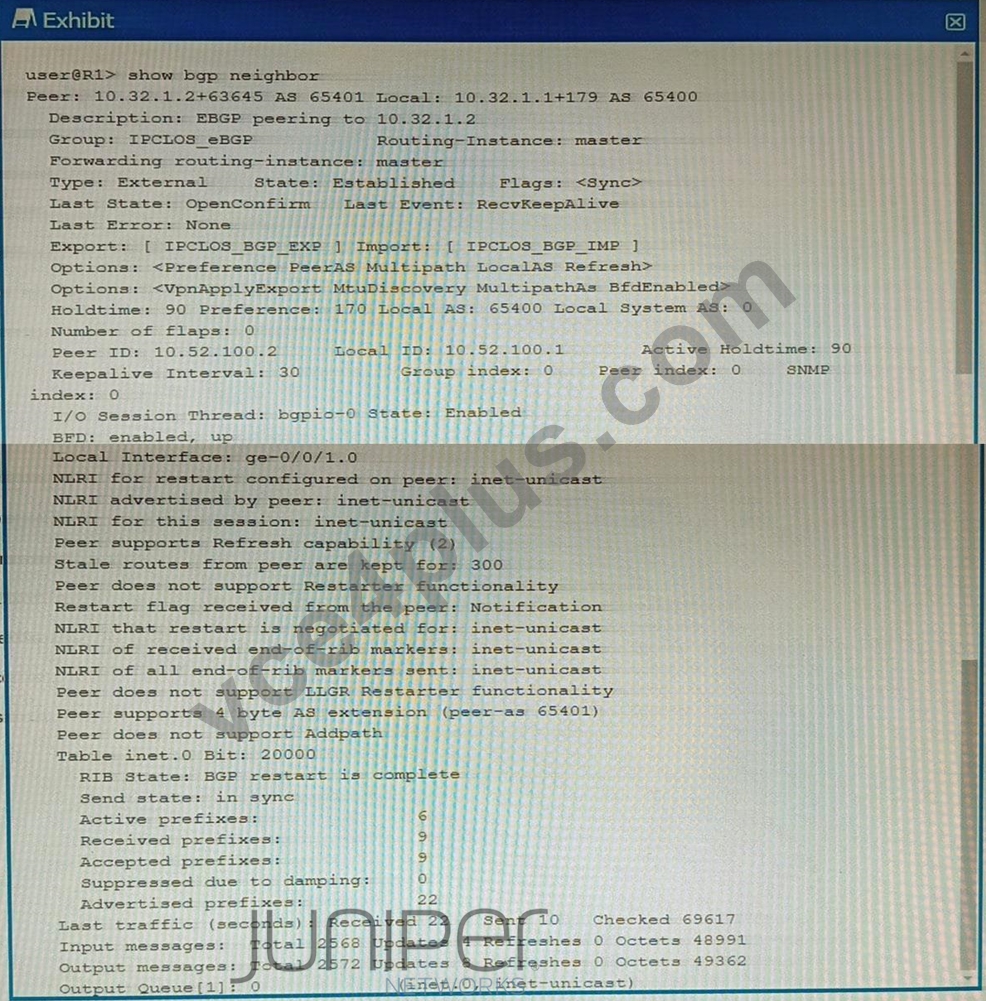
You are a network operator troubleshooting BGP connectivity.
Which two statements are correct about the output shown in the exhibit? (Choose two.)
- A. The R1 is configured for AS 65400.
- B. Peer 10.32.1.2 is configured for AS 63645.
- C. The routers are exchanging IPv4 routes.
- D. The BGP session is not established.
Answer: A,D
Explanation:
Explanation
Option B suggests that the BGP session is not established. This is correct because in the output, the state of the BGP session is shown as "Idle". In BGP, an "Idle" state means that the BGP session is not currently established1.
Option C suggests that R1 is configured for AS 65400. This is also correct because in the output, it's shown that the local AS number is 654001. The local AS number represents the Autonomous System (AS) number of the router on which you're checking the BGP session1.
NEW QUESTION # 120
......
Latest Juniper JN0-351 Dumps with Test Engine and PDF: https://braindumpsschool.vce4plus.com/Juniper/JN0-351-valid-vce-dumps.html