

DP-600 Practice Exam Tests Latest Updated on May-2025
Pass DP-600 Exam in First Attempt Guaranteed Dumps!
Microsoft DP-600 Exam Syllabus Topics:
| Topic | Details |
|---|---|
| Topic 1 |
|
| Topic 2 |
|
| Topic 3 |
|
NEW QUESTION # 108
You have a custom Direct Lake semantic model named Model1 that has one billion rows of data.
You use Tabular Editor to connect to Model1 by using the XMLA endpoint.
You need to ensure that when users interact with reports based on Model1, their queries always use Direct Lake mode.
What should you do?
- A. From Model, configure the Default Mode option.
- B. From Partitions, configure the Mode option.
- C. From Model, configure the Direct Lake Behavior option.
- D. From Model, configure the Storage Location option.
Answer: C
Explanation:
Click on Semantic model.
In the Properties pane, choose the Direct Lake behavior for your custom Direct Lake semantic model:
Automatic: This is the default behavior. It allows Direct Lake with fallback to DirectQuery mode if data can't be efficiently loaded into memory.
Direct Lake only: This option ensures no fallback to DirectQuery mode
https://powerbi.microsoft.com/en-au/blog/leveraging-pure-direct-lake-mode-for-maximum-query- performance/
NEW QUESTION # 109
Hotspot Question
You have a Fabric tenant that contains the semantic model shown in the following exhibit.
Use the drop-down menus to select the answer choice that completes each statement based on the information presented in the graphic.
NOTE: Each correct selection is worth one point.
Answer:
Explanation:
NEW QUESTION # 110
Hotspot Question
You have a Fabric tenant that contains a workspace named Workspace1 and a user named DBUser. Workspace1 contains a lakehouse named Lakehouse1. DBUser does NOT have access to the tenant.
You grant DBUser access to Lakehouse1 as shown in the following exhibit.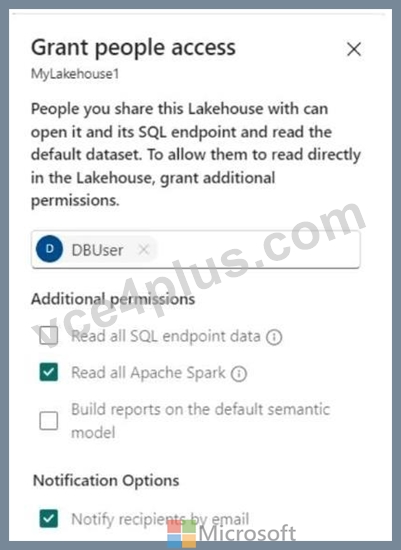
Use the drop-down menus to select the answer choice that completes each statement based on the information presented in the graphic.
NOTE: Each correct selection is worth one point.
Answer:
Explanation:
NEW QUESTION # 111
You have a Fabric warehouse that contains a table named Sales.Products. Sales.Products contains the following columns.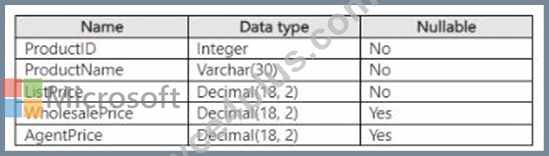
You need to write a T-SQL query that will return the following columns.
How should you complete the code? To answer, select the appropriate options in the answer area.
Answer:
Explanation: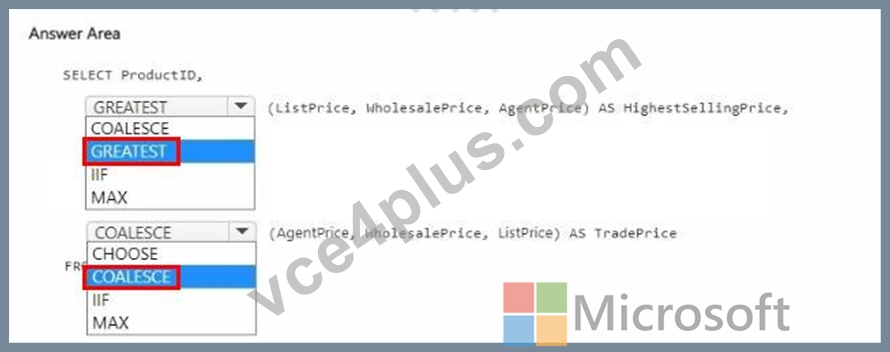
NEW QUESTION # 112
You create a semantic model by using Microsoft Power Bl Desktop. The model contains one security role named SalesRegionManager and the following tables:
* Sales
* SalesRegion
* Sales Ad dress
You need to modify the model to ensure that users assigned the SalesRegionManager role cannot see a column named Address in Sales Address.
Which three actions should you perform in sequence? To answer, move the appropriate actions from the list of actions to the answer area and arrange them in the correct order.
Answer:
Explanation: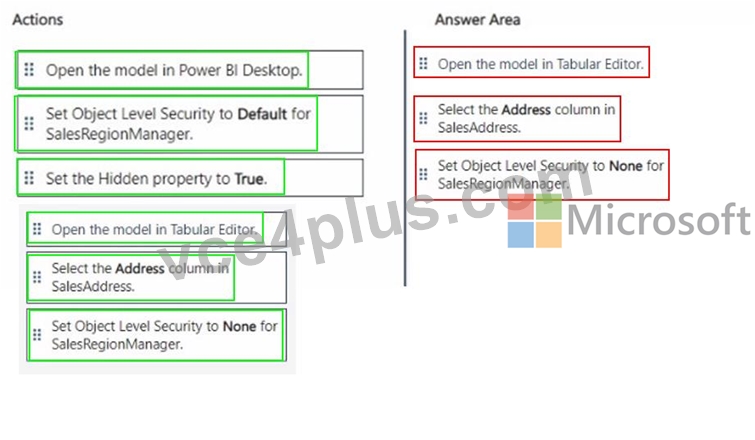
NEW QUESTION # 113
You have a Fabric tenant named Tenant1 that contains a lakehouse named Lakehouse1.
You need to add data to Lakehouse1 from a CSV file in an Azure Storage account outside of Fabric. The solution must minimize development effort.
What should you use to add the data?
- A. shortcut
- B. copy job
- C. Dataflow Gen2
- D. pipeline
Answer: A
NEW QUESTION # 114
You have a Fabric workspace that contains a DirectQuery semantic model. The model queries a data source that has 500 million rows.
You have a Microsoft Power Bi report named Report1 that uses the model. Report1 contains visuals on multiple pages.
You need to reduce the query execution time for the visuals on all the pages.
What are two features that you can use? Each correct answer presents a complete solution, NOTE: Each correct answer is worth one point.
- A. OneLake integration
- B. query caching
- C. automatic aggregation
- D. user-defined aggregations
Answer: C,D
NEW QUESTION # 115
Hotspot Question
You have the following KQL query.
For each of the following statements, select Yes if the statement is true. Otherwise, select No.
NOTE: Each correct selection is worth one point.
Answer:
Explanation: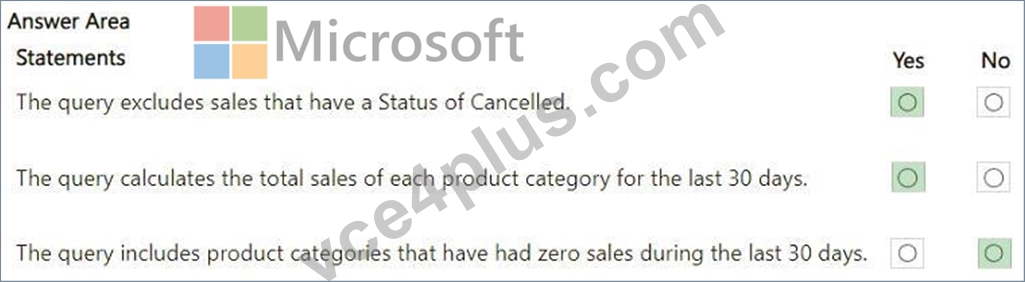
NEW QUESTION # 116
Case Study 1 - Contoso
Overview
Contoso, Ltd. is a US-based health supplements company. Contoso has two divisions named Sales and Research. The Sales division contains two departments named Online Sales and Retail Sales. The Research division assigns internally developed product lines to individual teams of researchers and analysts.
Existing Environment
Identity Environment
Contoso has a Microsoft Entra tenant named contoso.com. The tenant contains two groups named ResearchReviewersGroup1 and ResearchReviewersGroup2.
Data Environment
Contoso has the following data environment:
- The Sales division uses a Microsoft Power BI Premium capacity.
- The semantic model of the Online Sales department includes a fact table named Orders that uses Import made. In the system of origin, the OrderID value represents the sequence in which orders are created.
- The Research department uses an on-premises, third-party data warehousing product.
- Fabric is enabled for contoso.com.
- An Azure Data Lake Storage Gen2 storage account named storage1 contains Research division data for a product line named Productline1. - The data is in the delta format.
- A Data Lake Storage Gen2 storage account named storage2 contains Research division data for a product line named Productline2. The data is in the CSV format.
Requirements
Planned Changes
Contoso plans to make the following changes:
- Enable support for Fabric in the Power BI Premium capacity used by the Sales division.
- Make all the data for the Sales division and the Research division available in Fabric.
- For the Research division, create two Fabric workspaces named Productline1ws and Productine2ws.
- In Productline1ws, create a lakehouse named Lakehouse1.
- In Lakehouse1, create a shortcut to storage1 named ResearchProduct.
Data Analytics Requirements
Contoso identifies the following data analytics requirements:
- All the workspaces for the Sales division and the Research division must support all Fabric experiences.
- The Research division workspaces must use a dedicated, on-demand capacity that has per- minute billing.
- The Research division workspaces must be grouped together logically to support OneLake data hub filtering based on the department name.
- For the Research division workspaces, the members of ResearchReviewersGroup1 must be able to read lakehouse and warehouse data and shortcuts by using SQL endpoints.
- For the Research division workspaces, the members of ResearchReviewersGroup2 must be able to read lakehouse data by using Lakehouse explorer.
- All the semantic models and reports for the Research division must use version control that supports branching.
Data Preparation Requirements
Contoso identifies the following data preparation requirements:
- The Research division data for Productline1 must be retrieved from Lakehouse1 by using Fabric notebooks.
- All the Research division data in the lakehouses must be presented as managed tables in Lakehouse explorer.
Semantic Model Requirements
Contoso identifies the following requirements for implementing and managing semantic models:
- The number of rows added to the Orders table during refreshes must be minimized.
- The semantic models in the Research division workspaces must use Direct Lake mode.
General Requirements
Contoso identifies the following high-level requirements that must be considered for all solutions:
- Follow the principle of least privilege when applicable.
- Minimize implementation and maintenance effort when possible.
Which syntax should you use in a notebook to access the Research division data for Productline1?
- A. spark.read.format("delta").load("Tables/ResearchProduct")
- B. spark.read.format("delta").load("Tables/productline1/ResearchProduct")
- C. external_table(ResearchProduct)
- D. spark.sql("SELECT * FROM Lakehouse1.Tables.ResearchProduct")
Answer: A
Explanation:
This syntax correctly specifies the format as Delta and loads the data from the specified table in the lakehouse.
NEW QUESTION # 117
You have a Fabric warehouse that contains a table named Sales.Orders. Sales.Orders contains the following columns.
You need to write a T-SQL query that will return the following columns.
How should you complete the code? To answer, select the appropriate options in the answer area.
NOTE: Each correct selection is worth one point.
Answer:
Explanation:
Explanation:
For the PeriodDate that returns the first day of the month for OrderDate, you should use DATEFROMPARTS as it allows you to construct a date from its individual components (year, month, day).
For the DayName that returns the name of the day for OrderDate, you should use DATENAME with the weekday date part to get the full name of the weekday.
The complete SQL query should look like this:
SELECT OrderID, CustomerID,
DATEFROMPARTS(YEAR(OrderDate), MONTH(OrderDate), 1) AS PeriodDate,
DATENAME(weekday, OrderDate) AS DayName
FROM Sales.Orders
Select DATEFROMPARTS for the PeriodDate and weekday for the DayName in the answer area.
NEW QUESTION # 118
You are creating a semantic model in Microsoft Power Bl Desktop.
You plan to make bulk changes to the model by using the Tabular Model Definition Language (TMDL) extension for Microsoft Visual Studio Code.
You need to save the semantic model to a file.
Which file format should you use?
- A. PBIT
- B. PBIP
- C. PBIX
- D. PBIDS
Answer: C
Explanation:
When saving a semantic model to a file that can be edited using the Tabular Model Scripting Language (TMSL) extension for Visual Studio Code, the PBIX (Power BI Desktop) file format is the correct choice. The PBIX format contains the report, data model, and queries, and is the primary file format for editing in Power BI Desktop. Reference = Microsoft's documentation on Power BI file formats and Visual Studio Code provides further clarification on the usage of PBIX files.
NEW QUESTION # 119
What should you recommend using to ingest the customer data into the data store in the AnatyticsPOC workspace?
- A. a Spark notebook
- B. a stored procedure
- C. a pipeline that contains a KQL activity
- D. a dataflow
Answer: D
Explanation:
For ingesting customer data into the data store in the AnalyticsPOC workspace, a dataflow (D) should be recommended. Dataflows are designed within the Power BI service to ingest, cleanse, transform, and load data into the Power BI environment. They allow for the low-code ingestion and transformation of data as needed by Litware's technical requirements. Reference = You can learn more about dataflows and their use in Power BI environments in Microsoft's Power BI documentation.
NEW QUESTION # 120
You have a Fabric workspace that uses the default Spark starter pool and runtime version 1,2.
You plan to read a CSV file named Sales.raw.csv in a lakehouse, select columns, and save the data as a Delta table to the managed area of the lakehouse. Sales_raw.csv contains 12 columns.
You have the following code.
For each of the following statements, select Yes if the statement is true. Otherwise, select No. NOTE: Each correct selection is worth one point.
Answer:
Explanation:
NEW QUESTION # 121
Hotspot Question
You have a Fabric warehouse that contains the following data.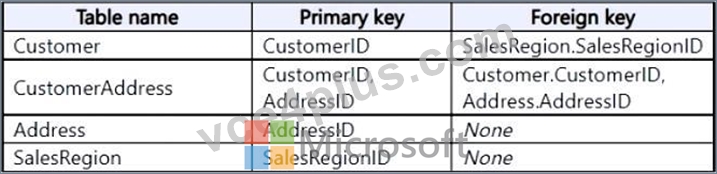
The data has the following characteristics:
- Each customer is assigned a unique CustomerID value.
- Each customer is associated to a single SalesRegion value.
- Each customer is associated to a single CustomerAddress value.
- The Customer table contains 5 million rows.
- All foreign key values are non-null.
You need to create a view to denormalize the data into a customer dimension that contains one row per distinct CustomerID value. The solution must minimize query processing time and resources.
How should you complete the T-SQL statement? To answer, select the appropriate options in the answer area.
NOTE: Each correct selection is worth one point.
Answer:
Explanation:
NEW QUESTION # 122
You have a Fabric workspace named Workspace 1 that contains a dataflow named Dataflow1. Dataflow! has a query that returns 2.000 rows. You view the query in Power Query as shown in the following exhibit.
What can you identify about the pickupLongitude column?
- A. All the table rows are profiled.
- B. The column has duplicate values.
- C. The column has missing values.
- D. There are 935 values that occur only once.
Answer: B
Explanation:
The pickupLongitude column has duplicate values. This can be inferred because the 'Distinct count' is 935 while the 'Count' is 1000, indicating that there are repeated values within the column. Reference = Microsoft Power BI documentation on data profiling could provide further insights into understanding and interpreting column statistics like these.
NEW QUESTION # 123
You have a Fabric tenant that contains a warehouse.
A user discovers that a report that usually takes two minutes to render has been running for 45 minutes and has still not rendered.
You need to identify what is preventing the report query from completing.
Which dynamic management view (DMV) should you use?
- A. sys.dm_exec_connections
- B. sys.dm_pdw_exec_requests
- C. sys.dm_exec_sessions
- D. sys.dm_exec_requests
Answer: D
Explanation:
https://learn.microsoft.com/en-us/fabric/data-warehouse/monitor-using-dmv
NEW QUESTION # 124
Note: This section contains one or more sets of questions with the same scenario and problem. Each question presents a unique solution to the problem. You must determine whether the solution meets the stated goals. More than one solution in the set might solve the problem. It is also possible that none of the solutions in the set solve the problem.
After you answer a question in this section, you will NOT be able to return. As a result, these questions do not appear on the Review Screen.
Your network contains an on-premises Active Directory Domain Services (AD DS) domain named contoso.com that syncs with a Microsoft Entra tenant by using Microsoft Entra Connect.
You have a Fabric tenant that contains a semantic model.
You enable dynamic row-level security (RLS) for the mode! and deploy the model to the Fabric service.
You query a measure that includes the username () function, and the query returns a blank result.
You need to ensure that the measure returns the user principal name (UPNJ of a user.
Solution: You add user objects to the list of synced objects in Microsoft Entra Connect.
Does this meet the goal?
- A. No
- B. Yes
Answer: A
NEW QUESTION # 125
You have a Fabric tenant that contains a semantic model named Model1. Model1 uses Import mode. Model1 contains a table named Orders. Orders has 100 million rows and the following fields.
You need to reduce the memory used by Model! and the time it takes to refresh the model. Which two actions should you perform? Each correct answer presents part of the solution. NOTE: Each correct answer is worth one point.
- A. Replace TotalQuantity with a calculated column.
- B. Replace TotalSalesAmount with a measure.
- C. Split OrderDateTime into separate date and time columns.
- D. Convert Quantity into the Text data type.
Answer: B,C
NEW QUESTION # 126
You have a Fabric tenant that contains a new semantic model in OneLake.
You use a Fabric notebook to read the data into a Spark DataFrame.
You need to evaluate the data to calculate the min, max, mean, and standard deviation values for all the string and numeric columns.
Solution: You use the following PySpark expression:
df .sumary ()
Does this meet the goal?
- A. No
- B. Yes
Answer: B
Explanation:
Yes, the df.summary() method does meet the goal. This method is used to compute specified statistics for numeric and string columns. By default, it provides statistics such as count, mean, stddev, min, and max.
References = The PySpark API documentation details the summary() function and the statistics it provides.
NEW QUESTION # 127
You are creating a dataflow in Fabric to ingest data from an Azure SQL database by using a T-SQL statement.
You need to ensure that any foldable Power Query transformation steps are processed by the Microsoft SQL Server engine.
How should you complete the code? To answer, drag the appropriate values to the correct targets. Each value may be used once, more than once, or not at all. You may need to drag the split bar between panes or scroll to view content.
NOTE: Each correct selection is worth one point.
Answer:
Explanation: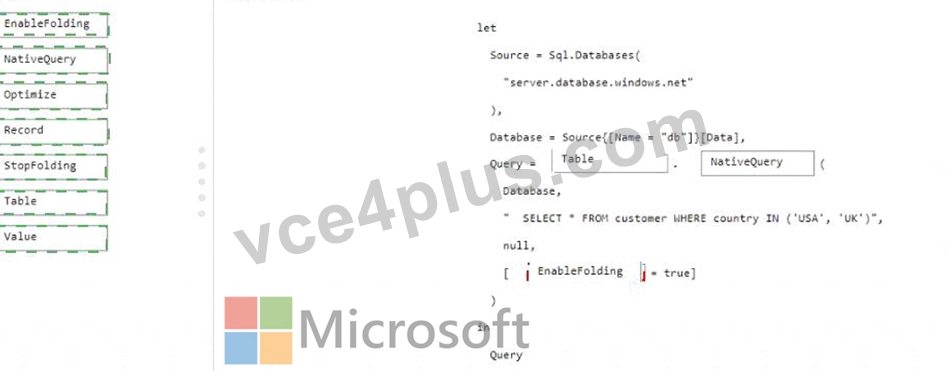
Explanation:
You should complete the code as follows:
* Table
* NativeQuery
* EnableFolding
In Power Query, using Table before the SQL statement ensures that the result of the SQL query is treated as a table. NativeQuery allows a native database query to be passed through from Power Query to the source database. The EnableFolding option ensures that any subsequent transformations that can be folded will be sent back and executed at the source database (Microsoft SQL Server engine in this case).
NEW QUESTION # 128
You are analyzing the data in a Fabric notebook.
You have a Spark DataFrame assigned to a variable named df.
You need to use the Chart view in the notebook to explore the data manually.
Which function should you run to make the data available in the Chart view?
- A. show
- B. displayHTML
- C. write
- D. display
Answer: D
NEW QUESTION # 129
Drag and Drop Question
You are creating a data flow in Fabric to ingest data from an Azure SQL database by using a T- SQL statement.
You need to ensure that any foldable Power Query transformation steps are processed by the Microsoft SQL Server engine.
How should you complete the code? To answer, drag the appropriate values to the correct targets. Each value may be used once, more than once, or not at all. You may need to drag the split bar between panes or scroll to view content.
NOTE: Each correct selection is worth one point.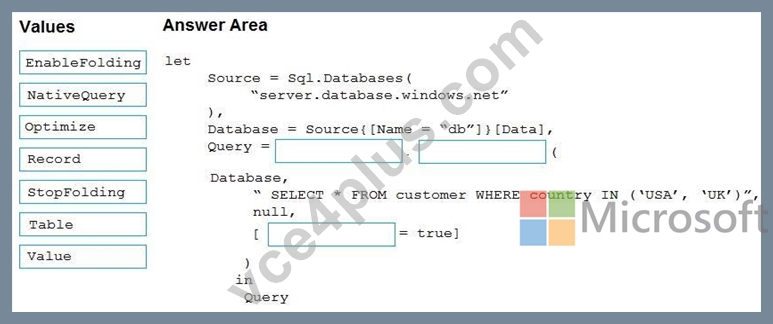
Answer:
Explanation:
Explanation:
https://learn.microsoft.com/en-us/power-query/native-query-folding
NEW QUESTION # 130
......
Microsoft Certified Free Certification Exam Material from VCE4Plus with 190 Questions: https://braindumpsschool.vce4plus.com/Microsoft/DP-600-valid-vce-dumps.html