

Free 2023 Microsoft Certified: Azure Data Engineer Associate DP-203 dumps are available on Google Drive shared by VCE4Plus
Welcome to download the newest VCE4Plus DP-203 PDF dumps: https://braindumpsschool.vce4plus.com/Microsoft/DP-203-valid-vce-dumps.html ( 302 Q&As)
To successfully pass the DP-203 exam, candidates must have a deep understanding of Azure data services, including Azure Stream Analytics, Azure Data Factory, Azure Cosmos DB, and Azure Databricks. They must also be proficient in working with SQL and NoSQL databases, designing and implementing data security solutions, and conducting data analysis using Azure services. Candidates will be tested on their ability to design, implement, and monitor data solutions on Azure, as well as their ability to optimize and troubleshoot Azure data solutions.
NEW QUESTION # 45
You are designing an anomaly detection solution for streaming data from an Azure IoT hub. The solution must meet the following requirements:
* Send the output to Azure Synapse.
* Identify spikes and dips in time series data.
* Minimize development and configuration effort.
Which should you include in the solution?
- A. Azure Databricks
- B. Azure SQL Database
- C. Azure Stream Analytics
Answer: C
Explanation:
Explanation
You can identify anomalies by routing data via IoT Hub to a built-in ML model in Azure Stream Analytics.
Reference:
https://docs.microsoft.com/en-us/learn/modules/data-anomaly-detection-using-azure-iot-hub/
NEW QUESTION # 46
You are designing an application that will store petabytes of medical imaging data When the data is first created, the data will be accessed frequently during the first week. After one month, the data must be accessible within 30 seconds, but files will be accessed infrequently. After one year, the data will be accessed infrequently but must be accessible within five minutes.
You need to select a storage strategy for the dat
a. The solution must minimize costs.
Which storage tier should you use for each time frame? To answer, select the appropriate options in the answer area.
NOTE: Each correct selection is worth one point.
Answer:
Explanation:
Reference:
https://docs.microsoft.com/en-us/azure/storage/blobs/storage-blob-storage-tiers
NEW QUESTION # 47
You have an Azure data factory.
You need to examine the pipeline failures from the last 180 flays.
What should you use?
- A. the Activity tog blade for the Data Factory resource
- B. Azure Data Factory activity runs in Azure Monitor
- C. Pipeline runs in the Azure Data Factory user experience
- D. the Resource health blade for the Data Factory resource
Answer: B
NEW QUESTION # 48
You have the following table named Employees.
You need to calculate the employee_type value based on the hire_date value.
How should you complete the Transact-SQL statement? To answer, drag the appropriate values to the correct targets. Each value may be used once, more than once, or not at all. You may need to drag the split bar between panes or scroll to view content.
NOTE: Each correct selection is worth one point.
Answer:
Explanation:
Reference:
https://docs.microsoft.com/en-us/sql/t-sql/language-elements/case-transact-sql
NEW QUESTION # 49
You use Azure Data Lake Storage Gen2 to store data that data scientists and data engineers will query by using Azure Databricks interactive notebooks. Users will have access only to the Data Lake Storage folders that relate to the projects on which they work.
You need to recommend which authentication methods to use for Databricks and Data Lake Storage to provide the users with the appropriate access. The solution must minimize administrative effort and development effort.
Which authentication method should you recommend for each Azure service? To answer, select the appropriate options in the answer area.
NOTE: Each correct selection is worth one point.
Answer:
Explanation: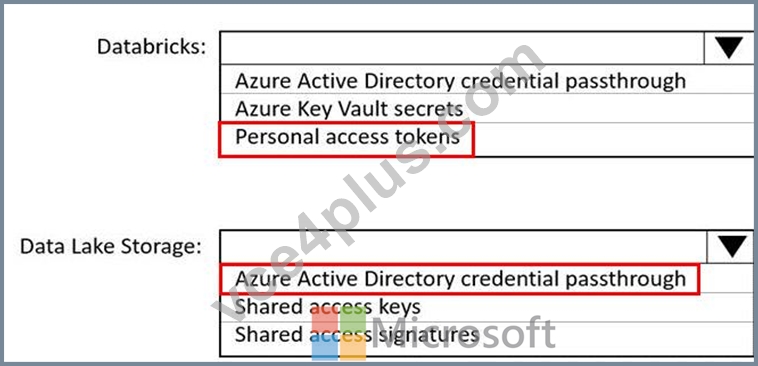
Reference:
https://docs.microsoft.com/en-us/azure/databricks/data/data-sources/azure/adls-gen2/azure-datalake-gen2-sas-access
https://docs.microsoft.com/en-us/azure/databricks/security/credential-passthrough/adls-passthrough
NEW QUESTION # 50
You are creating an Apache Spark job in Azure Databricks that will ingest JSON-formatted data.
You need to convert a nested JSON string into a DataFrame that will contain multiple rows.
Which Spark SQL function should you use?
- A. filter
- B. extract
- C. explode
- D. coalesce
Answer: C
Explanation:
Explanation
Convert nested JSON to a flattened DataFrame
You can to flatten nested JSON, using only $"column.*" and explode methods.
Note: Extract and flatten
Use $"column.*" and explode methods to flatten the struct and array types before displaying the flattened DataFrame.
Scala
display(DF.select($"id" as "main_id",$"name",$"batters",$"ppu",explode($"topping")) // Exploding the topping column using explode as it is an array type withColumn("topping_id",$"col.id") // Extracting topping_id from col using DOT form withColumn("topping_type",$"col.type") // Extracting topping_tytpe from col using DOT form drop($"col") select($"*",$"batters.*") // Flattened the struct type batters tto array type which is batter drop($"batters") select($"*",explode($"batter")) drop($"batter") withColumn("batter_id",$"col.id") // Extracting batter_id from col using DOT form withColumn("battter_type",$"col.type") // Extracting battter_type from col using DOT form drop($"col") ) Reference: https://learn.microsoft.com/en-us/azure/databricks/kb/scala/flatten-nested-columns-dynamically
NEW QUESTION # 51
You have an Azure Data Lake Storage Gen2 account that contains a JSON file for customers. The file contains two attributes named FirstName and LastName.
You need to copy the data from the JSON file to an Azure Synapse Analytics table by using Azure Databricks. A new column must be created that concatenates the FirstName and LastName values.
You create the following components:
A destination table in Azure Synapse
An Azure Blob storage container
A service principal
In which order should you perform the actions? To answer, move the appropriate actions from the list of actions to the answer area and arrange them in the correct order.
Answer:
Explanation:
Reference:
https://docs.microsoft.com/en-us/azure/azure-databricks/databricks-extract-load-sql-data-warehouse
NEW QUESTION # 52
You are building an Azure Analytics query that will receive input data from Azure IoT Hub and write the results to Azure Blob storage.
You need to calculate the difference in readings per sensor per hour.
How should you complete the query? To answer, select the appropriate options in the answer area.
NOTE: Each correct selection is worth one point.
Answer:
Explanation:
Reference:
https://docs.microsoft.com/en-us/stream-analytics-query/lag-azure-stream-analytics
NEW QUESTION # 53
You are designing a real-time dashboard solution that will visualize streaming data from remote sensors that connect to the internet. The streaming data must be aggregated to show the average value of each 10-second interval. The data will be discarded after being displayed in the dashboard.
The solution will use Azure Stream Analytics and must meet the following requirements:
Minimize latency from an Azure Event hub to the dashboard.
Minimize the required storage.
Minimize development effort.
What should you include in the solution? To answer, select the appropriate options in the answer are a.
NOTE: Each correct selection is worth one point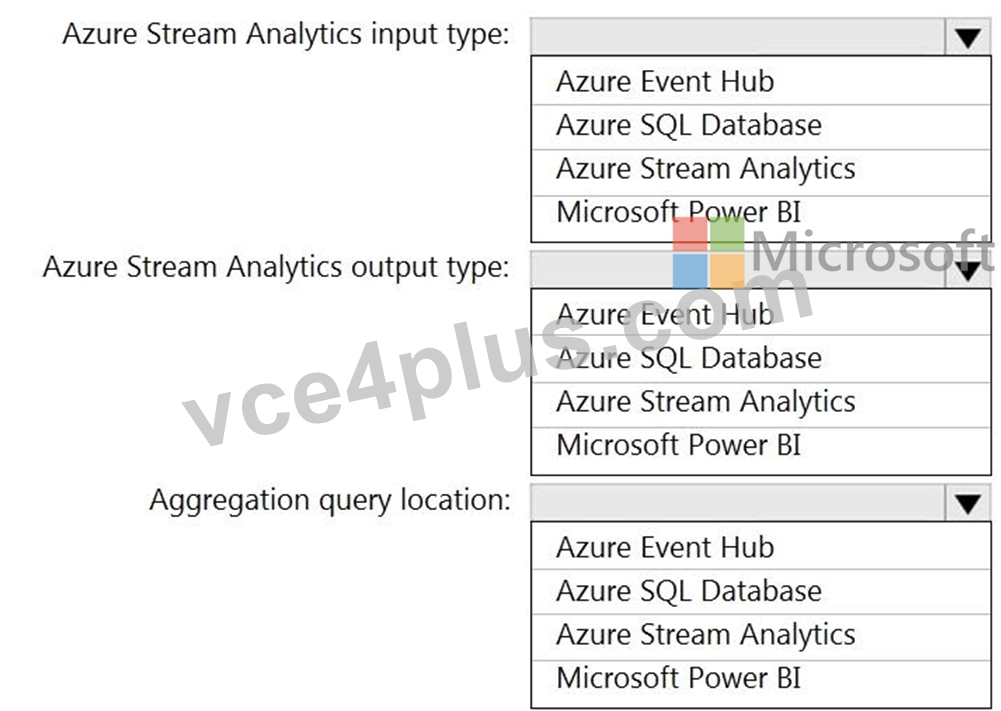
Answer:
Explanation:
Reference:
https://docs.microsoft.com/en-us/azure/stream-analytics/stream-analytics-power-bi-dashboard
NEW QUESTION # 54
You are designing an Azure Synapse Analytics dedicated SQL pool.
Groups will have access to sensitive data in the pool as shown in the following table.
You have policies for the sensitive dat
a. The policies vary be region as shown in the following table.
You have a table of patients for each region. The tables contain the following potentially sensitive columns.
You are designing dynamic data masking to maintain compliance.
For each of the following statements, select Yes if the statement is true. Otherwise, select No.
NOTE: Each correct selection is worth one point.
Answer:
Explanation: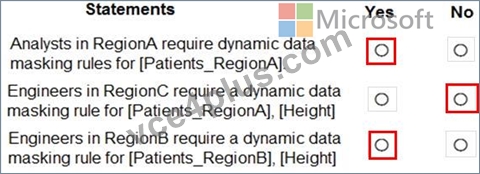
Reference:
https://docs.microsoft.com/en-us/azure/azure-sql/database/dynamic-data-masking-overview
NEW QUESTION # 55
You have an Azure event hub named retailhub that has 16 partitions. Transactions are posted to retailhub.
Each transaction includes the transaction ID, the individual line items, and the payment details. The transaction ID is used as the partition key.
You are designing an Azure Stream Analytics job to identify potentially fraudulent transactions at a retail store. The job will use retailhub as the input. The job will output the transaction ID, the individual line items, the payment details, a fraud score, and a fraud indicator.
You plan to send the output to an Azure event hub named fraudhub.
You need to ensure that the fraud detection solution is highly scalable and processes transactions as quickly as possible.
How should you structure the output of the Stream Analytics job? To answer, select the appropriate options in the answer area.
NOTE: Each correct selection is worth one point.
Answer:
Explanation:
Explanation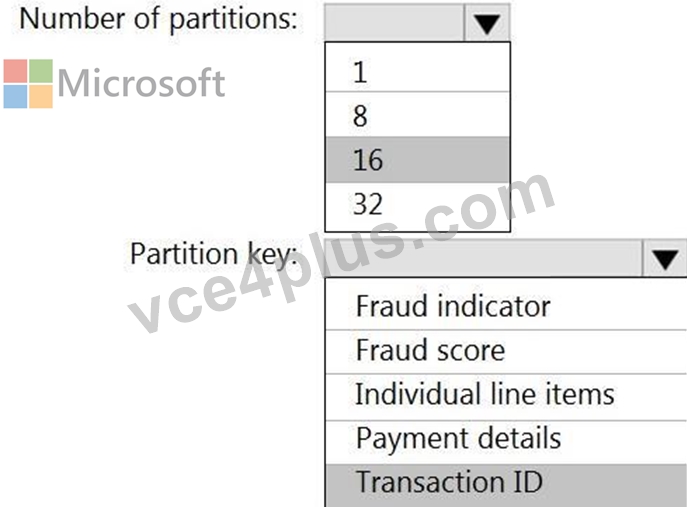
Box 1: 16
For Event Hubs you need to set the partition key explicitly.
An embarrassingly parallel job is the most scalable scenario in Azure Stream Analytics. It connects one partition of the input to one instance of the query to one partition of the output.
Box 2: Transaction ID
Reference:
https://docs.microsoft.com/en-us/azure/event-hubs/event-hubs-features#partitions
NEW QUESTION # 56
You are creating a new notebook in Azure Databricks that will support R as the primary language but will also support Scale and SOL Which switch should you use to switch between languages?
- A. Error! Hyperlink reference not valid.
- B. %<Language>
- C. @<Language>
- D. Error! Hyperlink reference not valid.
Answer: B
Explanation:
To change the language in Databricks' cells to either Scala, SQL, Python or R, prefix the cell with '%', followed by the language.
%python //or r, scala, sql
Reference:
https://www.theta.co.nz/news-blogs/tech-blog/enhancing-digital-twins-part-3-predictive-maintenance-with-azure-databricks
NEW QUESTION # 57
You have an on-premises data warehouse that includes the following fact tables. Both tables have the following columns: DateKey, ProductKey, RegionKey. There are 120 unique product keys and 65 unique region keys.
Queries that use the data warehouse take a long time to complete.
You plan to migrate the solution to use Azure Synapse Analytics. You need to ensure that the Azure-based solution optimizes query performance and minimizes processing skew.
What should you recommend? To answer, select the appropriate options in the answer area.
NOTE: Each correct selection is worth one point
Answer:
Explanation:
Reference:
https://docs.microsoft.com/en-us/azure/sql-data-warehouse/sql-data-warehouse-tables-distribute
NEW QUESTION # 58
You have an Azure subscription.
You need to deploy an Azure Data Lake Storage Gen2 Premium account. The solution must meet the following requirements:
* Blobs that are older than 365 days must be deleted.
* Administrator efforts must be minimized.
* Costs must be minimized
What should you use? To answer, select the appropriate options in the answer are a. NOTE Each correct selection is worth one point.
Answer:
Explanation:
NEW QUESTION # 59
You have an Azure Data Factory version 2 (V2) resource named Df1. Df1 contains a linked service.
You have an Azure Key vault named vault1 that contains an encryption key named key1.
You need to encrypt Df1 by using key1.
What should you do first?
- A. Add a private endpoint connection to vaul 1.
- B. Remove the linked service from Df1.
- C. Enable Azure role-based access control on vault 1.
- D. Create a self-hosted integration runtime.
Answer: B
Explanation:
Explanation
Linked services are much like connection strings, which define the connection information needed for Data Factory to connect to external resources.
Reference:
https://docs.microsoft.com/en-us/azure/data-factory/enable-customer-managed-key
https://docs.microsoft.com/en-us/azure/data-factory/concepts-linked-services
https://docs.microsoft.com/en-us/azure/data-factory/create-self-hosted-integration-runtime
NEW QUESTION # 60
You have an Azure Data Lake Storage Gen 2 account named storage1.
You need to recommend a solution for accessing the content in storage1. The solution must meet the following requirements:
List and read permissions must be granted at the storage account level.
Additional permissions can be applied to individual objects in storage1.
Security principals from Microsoft Azure Active Directory (Azure AD), part of Microsoft Entra, must be used for authentication.
What should you use? To answer, drag the appropriate components to the correct requirements. Each component may be used once, more than once, or not at all. You may need to drag the split bar between panes or scroll to view content.
NOTE: Each correct selection is worth one point.
Answer:
Explanation:
Explanation
Box 1: Role-based access control (RBAC) roles
List and read permissions must be granted at the storage account level.
Security principals from Microsoft Azure Active Directory (Azure AD), part of Microsoft Entra, must be used for authentication.
Role-based access control (Azure RBAC)
Azure RBAC uses role assignments to apply sets of permissions to security principals. A security principal is an object that represents a user, group, service principal, or managed identity that is defined in Azure Active Directory (AD). A permission set can give a security principal a "coarse-grain" level of access such as read or write access to all of the data in a storage account or all of the data in a container.
Box 2: Access control lists (ACLs)
Additional permissions can be applied to individual objects in storage1.
Access control lists (ACLs)
ACLs give you the ability to apply "finer grain" level of access to directories and files. An ACL is a permission construct that contains a series of ACL entries. Each ACL entry associates security principal with an access level.
Reference: https://learn.microsoft.com/en-us/azure/storage/blobs/data-lake-storage-access-control-model
NEW QUESTION # 61
......
Tested Material Used To DP-203: https://braindumpsschool.vce4plus.com/Microsoft/DP-203-valid-vce-dumps.html